






Ahead of the Medium-Term Budget Policy Statement (MTBPS) on Wednesday, 21 October, Zero Carbon Charge (CHARGE) reiterates its call on Finance Minister Enoch Godongwana to firstly, reform the tax burden on electric vehicles (EVs) and, secondly, fund renewable charging infrastructure that supports local production of clean energy for transport.
Government has taken important steps to support local EV production by incorporating EVs and their components into Phase 2 of the Automotive Production and Development Programme (APDP). Additionally, a 150% tax allowance for investment in new capacity to manufacture battery-electric or hydrogen-powered vehicles in South Africa came into effect on 1 March 2026.
CHARGE welcomes this progress. In his SA Auto Week address on 13 October, Parks Tau, Minister of Trade, Industry and Competition, identified charging equipment as an emerging value chain offering opportunities for local investment and supplier development. CHARGE believes this recognition should translate into practical support for renewable charging infrastructure alongside vehicle production.
However, the tax burden on imported EVs continues to make these vehicles less affordable and slow transport decarbonisation.
Minister Tau previously indicated that the review of the APDP and the South African Automotive Masterplan was expected to be completed by September 2026. Proposals under consideration included a review of the ad valorem tax structure to create clearer differentiation between locally produced and imported vehicles. Implementation of approved amendments was anticipated in the fourth quarter of the 2026/27 financial year, subject to the necessary approvals, including National Treasury’s concurrence.
In his latest SA Auto Week address, Minister Tau reiterated the importance of the APDP2 review but did not provide a completion date or details of proposed tax changes.
With Treasury concurrence required for any changes, the MTBPS provides an important opportunity to give industry clarity on the way forward. CHARGE is concerned that an ad valorem review focused on favouring local production could further increase the tax burden on imported EVs while local EV manufacturing capacity is still being developed.
Imported EVs still face substantial customs duties under the SARS tariff schedule, with the rate depending on classification and origin. Ad valorem excise duty and VAT are then added on top, further raising the retail price.
For example, an imported battery-electric passenger car with a customs value of R500,000, subject to the 25% general customs duty and no rebates, would attract R125,000 in customs duty and R141,750 in ad valorem excise duty. Together, these duties add R266,750 – more than half the vehicle’s customs value before VAT and other applicable costs.
“The result is a disconnect: government is incentivising domestic EV production while the tax structure continues to constrain the consumer demand that future production will depend on,” said Roux.
CHARGE is therefore calling on Treasury to use the MTBPS to provide a clear policy direction on EV taxation and charging infrastructure, and commit to measures that can be taken forward in Budget 2027, including:
-
- A restructuring of EV customs duties and ad valorem tax to ensure imported EVs are not taxed more heavily than comparable ICE vehicles.
- Targeted rebates or incentives for lower-priced EVs, to narrow the upfront cost gap with ICE vehicles.
- Access to concessional, long-term finance through development finance institutions, reflecting the long payback periods of infrastructure for developers.
- Dedicated funding for renewable energy micro-grids linked to charging stations, expanding local production of clean energy for transport and supporting industrial development without increasing pressure on the national grid.
Tax reform is only one side of the equation. The commercial case for expanding charging networks depends heavily on the pace of EV uptake, while greater access to reliable charging infrastructure gives consumers and businesses the confidence to make the switch.
The 2023 EV White Paper recognises charging infrastructure as a foundational pillar of the transition and acknowledges that off-grid solutions can support adoption without adding strain to the electricity system.
“This is an opportunity to decarbonise transport while developing local energy infrastructure and strengthening energy security. Localising the production of energy for transport offers government an immediate industrial opportunity with lasting economic benefits. The opportunity extends beyond manufacturing vehicles to producing the renewable energy that powers them, using technology and expertise already being deployed in South Africa. Support for renewable charging should form part of the same industrial vision as support for EV manufacturing,” said Roux.
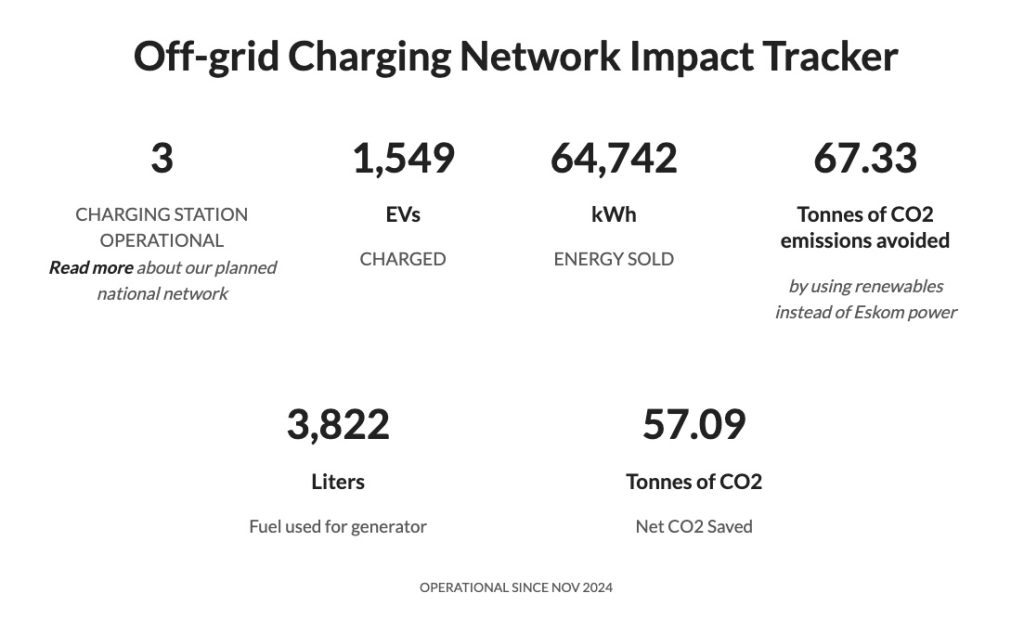
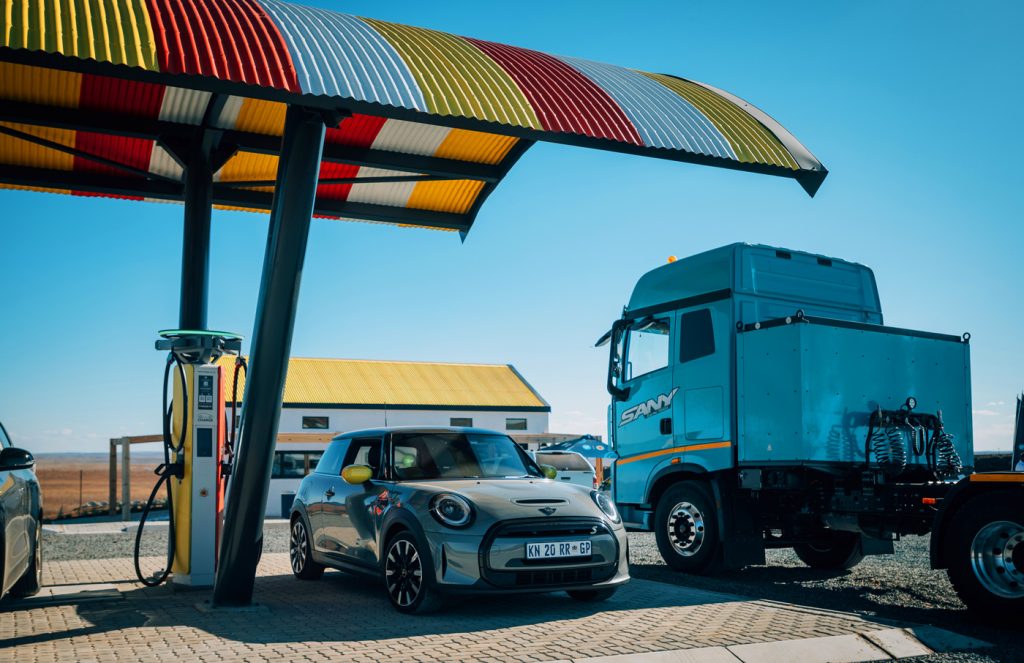
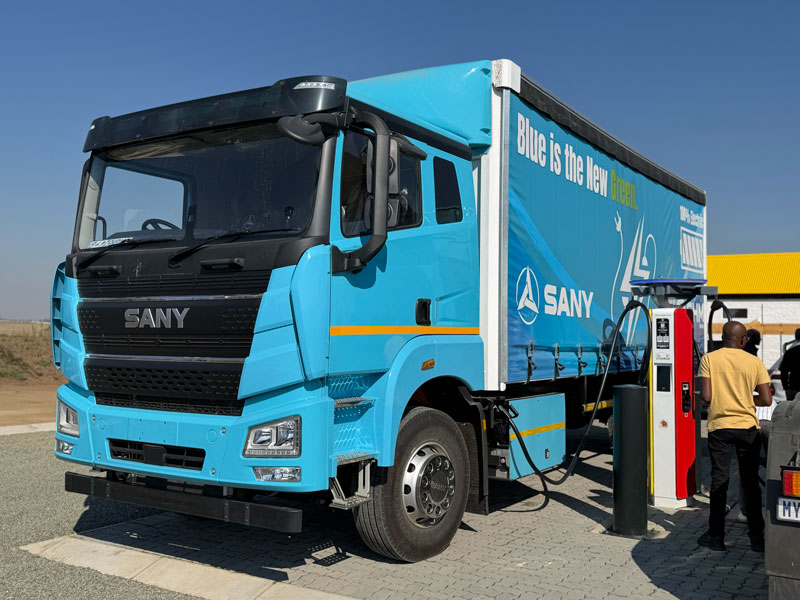
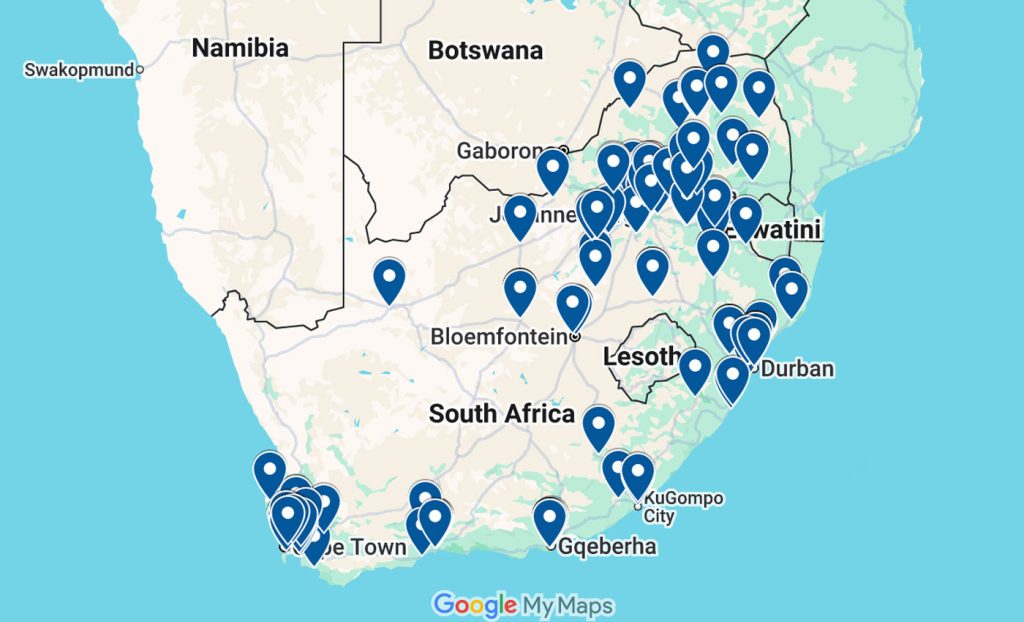
CHARGE’s fully off-grid, solar-powered fast-charging site in Wolmaransstad has proven the concept for passenger and electric truck charging. Its N3 corridor expansion, supported by a R100 million investment from the Development Bank of Southern Africa, is now showing how renewable charging infrastructure can help open South Africa’s busiest freight corridor to electric mobility and drive economic growth.
CHARGE CO2 IMPACT TRACKERLINKS
