




A Battle for Influence in the Green Transition
The electric vehicles market in South Africa is at a crucial turning point. As the country accelerates its transition toward cleaner transportation, two conflicting visions are developing: one from Europe, founded on structured climate financing and regulatory frameworks, and another from China, driven by aggressive investment in supply chains and market development. South Africa’s overall economic trajectory in the green energy age will be shaped by the decisions it makes now.
Europe’s Approach: Structured Climate Finance, Loan-Heavy, and Slower to Deploy
The European Union portrays itself as South Africa’s partner in a “just transition,” giving climate money attached to governance changes, worker protection, and compliance with global environmental standards. This takes expression most obviously through the Just Energy Transition Partnership, where the EU and its partners pledged $8.5 billion in 2021, later extended to $12.5 billion.
But this climate finance model is neither neutral nor fast. Recent analysis of OECD climate finance data from 2012 to 2023 reveals that the EU delivers more than half of its climate funding to the Global South as loans, not grants. Grants account for roughly 35 to 45 percent, while less than 10 percent comes through blended finance and private-sector instruments.
This matters profoundly for South Africa’s EV transition. Loans, especially those tied to regulatory reforms, tend to delay implementation. Because South Africa already faces fiscal constraints, loan-heavy packages can create hesitation among policymakers who must weigh climate goals against growing sovereign debt pressures.
The data also demonstrates that relatively little EU climate financing travels directly to the private sector. Instead, most money flows through national governments and multilateral development banks. This strategy supports long-term policy alignment, but it does little to quickly develop local EV manufacturing capacity, charging infrastructure, or battery supply chains: exactly the areas where private-sector dynamism is crucial.
The EU, as South Africa’s largest automotive export market, wields considerable influence through regulation as well as finance. With a ban on new ICE vehicle sales from 2035, European policy creates both pressure and opportunity. Since South Africa exports approximately 63% of the vehicles it produces, manufacturers cannot ignore these global shifts.
European partners are pushing South Africa toward long-term planning, regulatory reform, and alignment with global sustainability benchmarks. This top-down approach prioritises a just transition that protects workers and communities, but it moves at the pace of policy negotiation rather than market disruption. Europe’s model advances reform, but not always speed. For a country where EV adoption is surging 83% year-over-year and the export market faces a 2035 deadline, the pace of financing may be as important as the amount.
China’s Gambit: Owning the Supply Chain
China is playing a different game entirely. Rather than focusing on policy frameworks, Chinese companies are racing to lock down Africa’s critical mineral resources and establish manufacturing presence across the continent. Between 2014 and 2025, Chinese EV and battery firms invested $143 billion in foreign ventures, and in 2024, for the first time, they spent more on building the EV supply chain abroad than at home.
Africa has become central to this approach. In the second quarter of 2024, 75% of Chinese investment in raw resources flowed to Africa for the first time. The explanation is straightforward: lithium, cobalt, manganese, nickel, and graphite (minerals necessary for lithium-ion batteries) are found in Africa. South Africa is the world’s greatest manganese producer, whereas the Democratic Republic of Congo possesses around 71% of worldwide cobalt deposits.
China isn’t only harvesting these minerals; it’s developing an integrated supply chain that connects African resources straight to Chinese processing facilities. Over 80% of China’s imports of manganese and cobalt ore came from Africa in 2024. Chinese enterprises control 79% of African lithium output in 2025, a figure that’s anticipated to stay at 65% by 2035 even if worldwide production doubles.
For South Africa specifically, this creates both opportunities and dependencies. China is South Africa’s largest trading partner, and Chinese investments bring potential for job creation and technology transfer. But unlike Europe’s conditional finance, Chinese investment comes with fewer governance strings and moves at the speed of commerce. Chinese companies are building factories, not frameworks.
South Africa’s EV Market: Small but Surging

South Africa’s EV market is experiencing explosive growth from a low base. In the first quarter of 2024, 3,042 new energy vehicles were sold compared to 1,665 in the same period of 2023. Overall, NAAMSA reported a nearly 83% year-on-year increase in sales of electric and hybrid vehicles in early 2024.
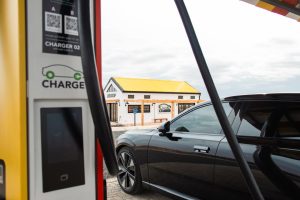
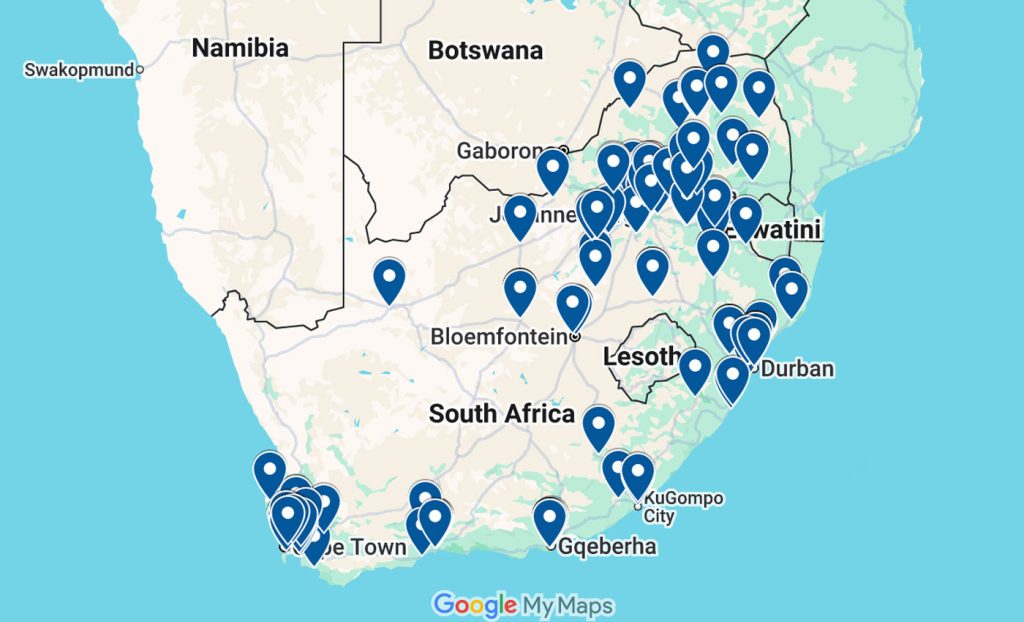
Infrastructure investment is accelerating to match this demand. Mercedes-Benz announced a R40 million investment to establish 127 charging stations. The Free State government partnered with Zero Carbon Charge for 120 charging stations with a $234 million investment. Cape Town announced a R8.5 billion tender for EV buses.
The government has responded with new incentives. In February 2024, Finance Minister Enoch Godongwana proposed a new subsidy starting March 2026 where manufacturers could claim 150% of any investment they make into electric and hydrogen-fuelled vehicles. The government also reprioritized R964 million to support the transition to EVs.
The Manufacturing Challenge
The South African EV market is projected to grow from $373.1 million in 2024 to approximately $1.01 billion by 2029, representing a compound annual growth rate of 21%. Despite the momentum, South Africa faces a fundamental challenge: it currently manufactures hybrid EVs but not pure electric vehicles. In December 2023, trade minister Ebrahim Patel announced that South Africa would likely manufacture its first pure EV in 2026.
The competition is fierce. Morocco has already secured a major win. Chinese battery manufacturer Gotion High-Tech signed a $6.4 billion agreement in June 2023 to build Africa’s first EV gigafactory in Morocco, with an annual capacity of 100 gigawatts. This positions Morocco as a continental hub for battery production while South Africa is still working to attract its first pure EV assembly line.
South Africa does have advantages. The country has existing car-building infrastructure, a skilled workforce, and world-class renewable energy resources.
Energy Independence and Economic Direction Are at Risk
The larger concern isn’t only about electric vehicles; it’s about South Africa’s standing in the burgeoning green economy. Will the nation become a high-value manufacturing hub linked with European norms and export markets? Or will it serve mainly as a provider of minerals and raw materials to Chinese supply chains?
Europe offers structured support tied to governance reforms and sustainability standards. This approach promises integration into global value chains and access to premium markets, but moves slowly through policy channels and comes with strings attached regarding labour rights and environmental standards.
China offers speed, capital, and vertical integration. Chinese companies can move from mineral extraction to battery production to vehicle assembly with minimal policy negotiation. But this approach creates dependencies on Chinese technology and supply chains, with less emphasis on local value addition beyond mining and basic manufacturing.
The Path Forward
South Africa is not required to select just one partner. The ideal plan certainly entails utilising both ties strategically: European financing and market access for high-value manufacturing, Chinese investment for mineral beneficiation and supply chain expansion.
However, time is of the essence. Global markets are evolving swiftly, and South Africa must make investment decisions immediately. Over 40% of South Africans are contemplating purchasing an electric car in the next five years, creating domestic demand that might boost local manufacture.
The country that positioned itself as Africa’s automotive manufacturing leader confronts a choice: adapt rapidly to the electric future or watch as that leadership transfers to Morocco, Egypt, or other African nations moving quicker to seize EV manufacturing and battery production.
For South African policymakers, the imperative is clear. The green transition isn’t coming; it’s here. The question is whether South Africa will drive it or simply be driven by it. The answer will determine not just the future of the automotive sector, but the trajectory of South Africa’s industrial economy for decades to come.
Lena Kyony is a passionate scholar specialising in international peace, African security, and sustainable development. With particular interest in the EU’s role in advancing the green transition, she draws on her academic work in Italy as well as her research in Southern Africa and governance experience in the Democratic Republic of Congo to explore pathways for impactful climate and policy change.
